Why Do Lactation Consultants Need CAQH (Now DataSpring)?
Categories: Credentialing, In-Network, CAQH / By Nicole Peluso IBCLC CD CAHPE
Editor’s Note (June 2026): CAQH recently rebranded as DataSpring. Because many insurance payers, credentialing organizations, and providers continue to refer to the platform as CAQH and CAQH ProView, this article uses the term “CAQH” throughout for clarity.
If you’re a lactation consultant who wants to bill insurance, one of the first acronyms you’ll run into is CAQH. It’s also one of the parts of credentialing that tends to confuse and overwhelm new providers. Here’s what CAQH actually is, why you need it, and how to use it to support your provider enrollment and billing processes.
Table of Contents
Few things are more frustrating for lactation consultants than diligently documenting a session in detailed SOAP notes, submitting them to insurance for reimbursement, and then receiving a denial after investing significant time and effort into the process. These rejections often stem from issues like incomplete or non-compliant documentation or formatting that doesn’t quite meet the payer’s expectations. Below, we’ll walk you through how to create clear, comprehensive lactation SOAP notes that strengthen claims, minimize denials, and help ensure you get the payment you deserve for the vital support you provide to families.
What Is CAQH?
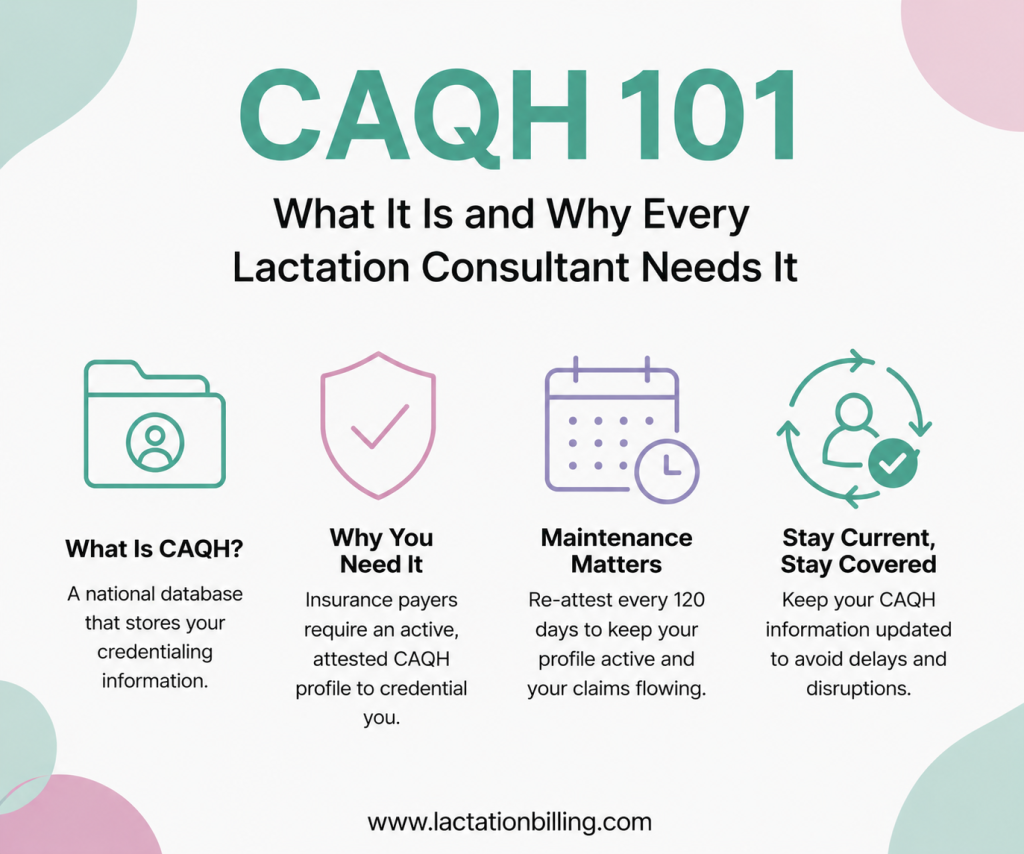
CAQH stands for the Council for Affordable Quality Healthcare. The piece you’ll interact with is called CAQH ProView, a free, national database where healthcare providers enter their demographic, credentialing, and professional information and then authorize insurance companies to pull it whenever they need it.
Think of it as a single, shared file cabinet. Instead of filling out a separate, lengthy credentialing application for every payer you want to work with, you build one detailed profile with your licenses and certifications, education, practice locations, malpractice coverage, and work history. CAQH allows you to then share this information with payers as you go through the credentialing process. “More than 900 insurance payers and organizations across the healthcare industry use CAQH data during credentialing and provider enrollment, including UnitedHealthcare, Aetna, Cigna, Tricare, and most Blue Cross Blue Shield plans.
Why Lactation Consultants Need an Account
Here’s the part that surprises new IBCLCs and CLCs: a CAQH profile isn’t optional if you want to be in-network. For the vast majority of commercial insurance companies, an active, attested CAQH profile is a prerequisite for credentialing. Without an active profile, many insurance companies cannot move forward with credentialing you.
In other words, CAQH sits at the very front of the chain that ends with you getting reimbursed for your visits. You can be the most skilled consultant in your state, but if a payer goes to verify your credentials and finds no usable profile, the application and registration process stalls before it begins.
A few things to keep in mind:
Each provider needs their own profile. CAQH is tied to your individual NPI. If you have two consultants in your practice, that’s two profiles with separate provider data for each person. You can’t share one account or CAQH ID number.
It’s free. Healthcare professionals never have to pay CAQH to maintain their profile.
Setting up an account takes time, especially for providers who are new to credentialing services and insurance billing. Put aside about 90 minutes for data entry and file uploads to properly set up your account.
The Part Many Providers Don’t Realize at First: Maintenance
Many providers assume CAQH is a one-time setup task, so they’re caught off guard when credentialing issues later trace back to an expired profile.
A CAQH profile is not a “set it and forget it” task. To stay usable and keep CAQH credentialing active, you have to re-attest. Attesting involves regularly logging in, reviewing everything, updating your credentialing information and practice information if necessary, and confirming it’s accurate. For most providers that’s every 120 days, roughly every four months. The clock runs from the date of your last attestation, not from the start of the year, so the date drifts a little each time.
If you miss that window, your CAQH Proview profile flips from “Active” to “Expired.” When that happens, payers can no longer pull your data. Re-credentialing stalls. And because many payers run automatic, behind-the-scenes data checks on your CAQH account, an expired profile can trigger claim holds or even get you dropped from a network, often weeks before anyone in your practice realizes anything is wrong.
Treat your re-attestation date like a recurring appointment you cannot skip. Put it on a calendar with a reminder a couple of weeks ahead, and make sure the email address on your profile is one you actually check. CAQH sends reminders, but they don’t help if they land in an inbox you’ve abandoned.
A Few More Things New Providers Should Know
Don’t wait for the 120-day cycle to update changes. If something material changes like a new practice location, a license renewal, a new malpractice policy, a name or tax ID change, update it right away and re-attest. Outdated information can create many of the same credentialing problems as an expired profile.
Authorize payer access. Completing your profile isn’t enough on its own. There’s an authorization step that gives insurance companies permission to view your data. The most reliable setting is to release your data to any organization that requests it; without it, a payer that wants to credential you may not be able to see your file at all.
Keep your documents current. CAQH lets you upload supporting documents like your professional liability insurance declaration page. Expired uploads are one of the most common and easily overlooked reasons credentialing applications get delayed, so refresh them as your policies renew.
Your home address is required. Even fully virtual providers have to enter a primary home address for credentialing. It won’t be published in online directories, but it’s mandatory.
The Bottom Line
CAQH is the foundation provider credentialing is built on. Get it set up correctly, then protect it by re-attesting on time and updating it the moment something changes. A profile that’s complete, attested, and current keeps your credentialing moving, your claims flowing, and patient care consistent. An outdated or expired profile can quietly create delays and administrative headaches for you and the lactation or medical practices you work under.
If setting up your CAQH application feels overwhelming, that’s normal. Many providers are surprised by how detailed credentialing services and insurance payer enrollment can be when they first enter the healthcare industry. It’s a long application with a lot of small decisions. For a step-by-step guide to success with your CAQH registration process, please use our article: CAQH Setup Instructions.