

Best Practices for Lactation SOAP Notes
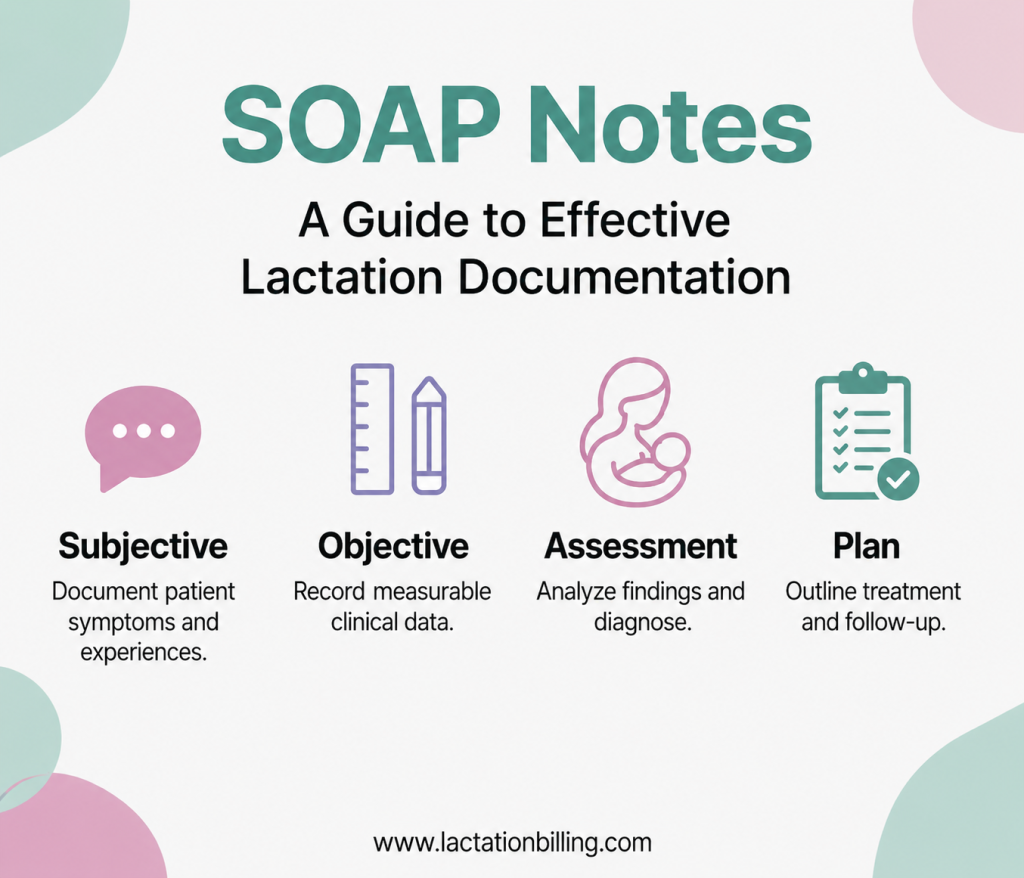
Categories: Charting, Compliance, Plan of Care / By Nicole Peluso IBCLC CD CAHPE
Few things are more frustrating for lactation consultants than diligently documenting a session in detailed SOAP notes, submitting them to insurance for reimbursement, and then receiving a denial after investing significant time and effort into the process. These rejections often stem from issues like incomplete or non-compliant documentation or formatting that doesn’t quite meet the payer’s expectations. Below, we’ll walk you through how to create clear, comprehensive lactation SOAP notes that strengthen claims, minimize denials, and help ensure you get the payment you deserve for the vital support you provide to families.
Table of Contents
Why Does Accurate Charting Matter?
Keeping thorough and correct clinical notes after each appointment in your outpatient clinic or private practice is essential for optimal practice management and effective patient care:
- Patient safety: A complete record helps you and future IBCLCs and CLCs, who may read and depend on your notes to understand your mutual patients’ histories and give the best care.
- Clear communication: Insurance reviewers rely on your notes to understand what happened at the visit in order to pay your insurance claims.
- Fair insurance coverage: If charting is incomplete or in the wrong place, insurance payers may deny payment, leaving the patient with unexpected costs.
Accurate charting protects your patients, supports your healthcare professional colleagues, and ensures visits are properly recorded and covered.
Are There Downloadable SOAP Note Templates I Can Use?
Yes, you can find templates for sale that can help you detail your progress notes. However, most lactation templates that you can purchase unfortunately veer off course from what a SOAP is intended to include by putting information in the wrong place and leaving out critical questions. The good news is that the SOAP note format itself is a broad template consisting of four distinct sections. If used properly, the four sections can help you work through a visit in an ideal pattern so that patient issues are properly addressed and you won’t need the prompts from a template. \
How Do EMRs Affect SOAP Note Formatting?
Most Electronic Medical Records (EMRs) provide generic space for you to write data about your patient and the visit. The most effective EMRs are not overly templated and allow you an opportunity to write out information without prompts. Too many prompts can derail the natural flow in a visit, and they can also over-complicate a medical record. When a medical record is reviewed by payer representatives or by payer automation, simplicity and clarity are critical components that will most likely result in an approved payment.
For both payer approval and general provider use, narrative clarity matters more than volume, so keep your SOAP notes precise and concise. Using both lists and narrative paragraphs is acceptable when logically organized.
Required Information at the Start of a SOAP Note
Recent guidelines for SOAP note documentation explain that each SOAP note should begin with a clear introduction that includes demographics and visit logistics. If you work in an outpatient or private practice setting as a lactation provider, you should always keep separate records for each patient – one for the lactating parent and one for the baby. Avoid charting the dyad together and clumping the mother’s and baby’s notes together. Insurers require that the medical record is connected only to the patient you submit the claim for.
For each SOAP note, for best results, be sure to include:
- Patient demographics: Patient’s full name, patient’s date of birth, patient’s sex/gender. Remember to only include the patient’s information – the mother OR the baby – not both.
- Visit details: Date, start and end time of visit or the total amount of minutes of the visit, type of visit (initial or follow-up), and location (in-person, virtual, home, hospital, etc.) A visit is considered initial when it’s for a new pregnancy or it’s been a year since the last initial visit (such as a weaning visit in year two).
- Provider information: Your name and credentials. Sometimes payers allow for billing under other providers, so you might bill under someone else or someone else might bill under you. When services are billed under a provider’s credential and payer enrollment, but services are rendered by a different individual who delivered the care, it’s important to clearly document each provider’s role in the medical record. Use neutral language that identifies responsibility without implying a specific supervision model unless required by the payer or practice. Clarifying each provider’s role matters for audits and claim matching. This documentation is only relevant when the billing and rendering providers are not the same person.
Example:
Billing / Credentialed Provider: Jane Smith, MD
Rendering Provider: Sara Smart, IBCLC
The Four Parts of the SOAP Format
SOAP notes are divided into four parts – Subjective, Objective, Assessment, and Plan – because this structure mirrors the natural clinical reasoning process from patient report to clinical decision-making. Separating what the patient says, what the clinician observes, how the information is interpreted, and what actions are taken creates clarity, reduces ambiguity, and allows other providers and payers to clearly follow the logic of care. This standardized format for SOAP notes supports continuity of care, medical-legal defensibility, and accurate insurance billing and reimbursement across healthcare settings.
1. Subjective Section
The Subjective section should document what the patient (or the patient’s mother, if baby) reports as the reason for the visit in her own words. Think of it as filling in the blank: “Patient reports….”.
The first reason listed is called the patient’s chief concern or complaint. A patient’s chief complaint is the main or most pressing reason they are seeking care, described concisely in their own words whenever possible. For example:
- “Chief Complaint: Pain while breastfeeding.”
- “Chief Complaint: Mother reports concern that her infant is not latching effectively.”
You can list the patient’s other concerns right below the chief complaint. For example:
- “Patient is also worried about her milk supply and is seeking help with pumping and returning to work.”
- “Mother additionally reports that she isn’t sure nursing is satisfying her baby who isn’t gaining enough weight, and she seeks guidance on how to combine breastfeeding and formula.”
The Subjective section is also the place where you can detail your patient’s history (also known as the “history of present illness (HPI)”) which can include patient-reported symptoms, concerns, and feedback, such as:
- Medical history: For the mother – pregnancy and delivery details and complications, gestational age at time of birth, relevant prior surgeries, current medications, allergies. For the baby – birth details, gestational age, NICU stay, medical concerns, current medications.
- Feeding history: Breastfeeding, pumping, bottle use, supplementation, prior challenges, nipple or breast pain, supply, infections. If a description of feedings that took place before the visit are provided, their description will go here. If a feeding happens during the visit, that information will go below in the Objective section.
- Family history: Relevant family medical conditions such as a mother or sister having breastfeeding challenges.
- Social history: Support system, return-to-work plans, cultural factors that may influence feeding.
- Lactation-specific history: Prior breastfeeding experience, prior consultations, outcomes.
Ask questions to obtain a full picture of the patient’s concerns.
2. Objective Section
The Objective section of the SOAP note is only what occurred or was directly observed/measured during the visit. Document what you personally observe during the visit in the Objective section of your SOAP notes, such as the mother’s nipple and breast health, how the parent positions the baby for feeding, the effectiveness of the infant’s latch, and feeding duration; do not add data about other feedings that didn’t happen at the visit which should be part of the Subjective historical report above. As you are observing, pay close attention to what the mother defined as her presenting problem.
- Include any measurable data from your physical exam findings that you discover that day, such as changes in breast health from the prior visit, infant weight, intake from a breast or bottle, or other relevant vital signs.
- Document scores from any formal assessments you performed on the patient, such as mental health assessments for the lactating parent or suck assessments for the baby. In order to get paid by insurance, assessments must be written, include an informed consent statement (“Parent consented to EPDS screening” or Parent consented to baby’s suck evaluation”), have a timestamp and display the total amount of time it took to complete the assessment, be scored with an explanation about how the score was calculated, and include your signature. If you took photos or videos to complete the assessment, attach them to the assessment.
3. Assessment Section
Analyze the Subjective and Objective information of your SOAP notes to form an opinion of the patient’s situation and write a statement expressing your clinical conclusion. If there is more than one situation happening, you may want to provide more than one assessment statement.
- Review the Subjective and Objective sections of your notes: Base your assessment on the evidence gathered from both the Subjective and Objective sections of the SOAP note. This includes what the patient (or parent) reported as concerns and what you directly observed or measured during the visit.
- Provide clinical rationale: Clearly distinguish between reported information and your clinical interpretation. The Assessment section is where you explain what the information means, not simply restate what was said or seen.
- How to structure your Assessment statement: A helpful way to organize and phrase an Assessment statement is: “Based on (select parts of what was reported in the Subjective section and parts of what were observed in the Objective section), the patient has (the clinical issue or diagnosis).”
- Don’t forget the chief complaint: The patient’s chief complaint is often a key element referenced in the Assessment. If the patient presents with more than one concern and those concerns represent separate clinical issues, you may include more than one Assessment statement, provided each is supported by the documented findings.
- Provide a clear diagnosis: Examples of lactation-based diagnoses are nipple pain, nipple abrasions, poor latch, insufficient milk supply, or infant weight concerns.
- ICD-10 not required: Including an ICD-10 diagnosis code in the SOAP note is not clinically required for good documentation. However, some EMRs, billing workflows, or practice policies may require diagnoses to be entered or linked elsewhere in the medical record for administrative or reimbursement purposes. When ICD-10 codes are included, the Assessment section is the most appropriate place to document them. If you are unsure of your practice’s expectations, confirm requirements with your supervisor or billing team.
- Secondary complaints not assessed: If there are patient concerns that you have not assessed, you should acknowledge them and then explain why you have decided not to assess them. Reasons you may not assess concerns could include deferring them for future visits, referring the concern out to another provider, or providing resources for the patient to read.
4. Plan Section
Break the Plan of Care section into two parts: “Counseling/Education” and “Recommendations.”
Counseling and Education:
Share what you taught the patient during the visit. If you provided any links to blogs, articles, podcasts, studies, or videos, you can provide those links in this section.
Recommendations:
Payers look for actionable and specific recommendations that link to the Assessment.
- The chief complaint should always be addressed in the Plan of Care with a clear course of action for the patient to take
- Recommendations for secondary concerns should be addressed if time allows.
- Make sure you outline clear frequency, duration, and follow-up expectations when applicable.
- Detail the treatment plan, including strategies and step-by-step instructions.
- State the time of any scheduled future appointment(s).
- State any referrals to other healthcare providers.
Often, providers will copy the recommendations part of the SOAP note in a secure email to the patient or in the patient portal for the patient to reference later.
The Signature: The Final Section
To close out your SOAP notes, it is important to sign and date your record. For records with more than one provider, list both names and their roles along with the date and time of signature. Only the rendering provider is required to sign. Example:
Rendered by:
Sara Smart, IBCLC
Date / Time
Billing Provider:
Brenda Jones, RN-IBCLC
The rendering provider’s signature is always required on the standalone SOAP note. The only exception would be if an EMR has signatures set up as part of the login procedure where the provider is authenticated by the login. It is not necessary to include the billing provider’s signature, but you must include the billing provider’s name. There is no need to include the NPI in the signature section or anywhere on your SOAP notes.
General Best Practices
- Chart mother and baby separately: Always chart separately for mother and baby according to the guidelines above, so each has a clear, complete medical record. It is OK to duplicate certain information in both charts but the charts should never be mingled in outpatient and private practice records. Note that some hospital EMRs require dyad charting due to maternity billing practices where the birth and postpartum care are bundled together.
- Be concise and clear: Write with clear, direct language and avoid unnecessary jargon or slang. Avoid abbreviations, since they can be unclear, hard to read, or mean different things to different providers.
- Create promptly: Ensure notes are written during the visit and edited/finalized immediately after each consultation to guarantee accuracy. It’s common to forget details if there is any delay in completing your notes.
- Proofread and sign: Review your notes for accuracy, completeness, and grammar before finalizing them. Sign and date your records upon completion, and do not make changes after the record is signed. If new information needs to be added or existing information needs to be changed after the record is signed, amendments should be handled as dated addenda, not silent edits.
- Protect privacy: Always maintain patient confidentiality and comply with HIPAA regulations.
- Your best is good enough: SOAP notes do not need to be perfect. Clear logic and consistency matter more than length or fancy language.
SOAP Note Support and Reliable Reimbursement
SOAP notes are just one piece of the reimbursement puzzle. Understanding how documentation, coding, and payer rules interact is often what determines whether visits are paid or denied. You don’t have to navigate that complexity alone as your practice grows and evolves. LCB is happy to meet you at one of our info sessions. Book here and let’s have a conversation about your goals.